A Century of Culture, Architecture and Community

What We Are Today
The Makiya Foundation is a registered charity in London, number 1017788. We award grants to individuals and organisations worldwide whose work advances public understanding of Arab Islamic culture. That means architecture, visual arts, music, literature, and everything in between. 
We maintain an archive. We host events. We sponsor the annual Mohamed Makiya Prize for Architecture through our partnership with the Tamayouz Excellence Award. We support writers across the Arab world who struggle to make a living.
But the Makiya Foundation is not just a grant-making body. It is the living continuation of something that began nearly forty years ago in a Victorian hall on Westbourne Grove, and something that began even earlier, in a courtyard house in Baghdad, when a young architect opened his front room to a group of artists because the city had nowhere else for them to show their work.
 
The Kufa Gallery
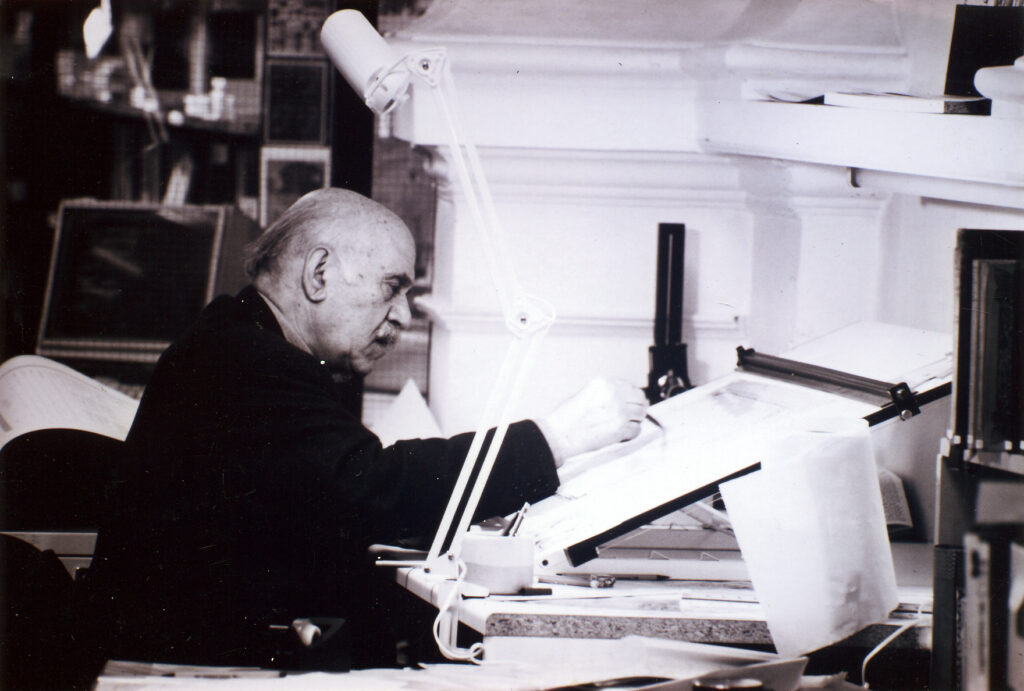
In December 1986, Dr Mohamed Makiya opened the Kufa Gallery at 26 Westbourne Grove, in the heart of London’s Bayswater. He had bought a listed Victorian hall that was being used as a warehouse for Chubb locks and safes. The building was beautiful and neglected. Makiya was convinced it deserved to be seen and used. The re-flooring alone took a full year. He moved his architectural practice upstairs to help pay for it.
He named it after the ancient Iraqi city of Kufa, where he had once dreamed of building a university dedicated to intellectual advancement in an atmosphere of compassion and tolerance. That dream had collapsed. With this gallery, he said, he was bringing “the hopes of the Euphrates to the environs of the Thames.”
The Kufa Gallery was designed as a diwaniya, a traditional Arab meeting place. It shared its space with the Al-Saqi bookshop, one of London’s leading specialists in Middle Eastern literature. The inaugural exhibition in January 1987 celebrated forty years of Makiya’s own architectural work. Over the next two decades, it hosted exhibitions of Arabic calligraphy, Palestinian children’s art, photographs of Kurdistan, Indian contemporary art, Yemeni children’s drawings, and a major exhibition on the Iraq Marshes, accompanied by a full symposium. Lectures ranged from Michael Wood on the origins of civilisation to Dr Zaki Badawi on tolerance between faiths. There were evenings of storytelling from One Thousand and One Nights.
Rose Issa, who would become one of the world’s most important curators of Middle Eastern art, was invited by Makiya to launch the gallery. It became the first venue in London dedicated to promoting art from the Middle East.
In May 1993, the Kufa Gallery became a registered charity. Its mission was to anchor “the Kufic traditions of enlightenment and compassion in the heart of London, and to extend the hand of tolerance to a larger public.”
In 2006, after Makiya fell and broke his hip following a lecture at the gallery, the doors closed for good. He was devastated. He had hoped to recreate a miniature version in his flat. It never happened.
 
The Kufa Gallery was not the beginning. It was a continuation.
In the 1940s, Baghdad had no art galleries. None. So Mohamed Makiya, then a young architect recently returned from England, opened his home and hosted the city’s first contemporary art exhibition. The artist was Jawad Saleem. The venue was Makiya’s living room.
In the 1960s, he co-founded al-Wasiti Gallery with Said Ali Madhloom and Henry Zvobodal. It was Baghdad’s first commercial gallery. It introduced artists to the public. It changed the art market in the city. Makiya also built a private collection of over 270 works of modern Arab art, one of the most significant in the region.
He did all this while founding the Department of Architecture at Baghdad University in 1959, serving as Professor of Islamic Architecture until 1968, and designing a curriculum that required students to engage with Iraqi vernacular buildings and classical Islamic sources before they disappeared. The department has since graduated thousands of architects who work across the world.
At the same time designing the al-Khulafa Mosque, his masterpiece, completed in 1963, where he wove a 9th-century minaret into a new design with a harmony no rigid modernist could have achieved. His son Kanan would later coin the term “Post-Islamic Classicism” to describe his father’s work: architecture “cut off from its original sources by a chasm of 1,000 years, yet expressing a deep nostalgia, a longing to continue where they left off.”
Makiya was a man who believed in institutions and the importance of civic society; he was the Head of the Iraqi Artists Society, campaigning for government support regardless of who was in power, and writing to Abdul Karim Qassim within a week of the 1958 revolution to make sure the new government backed the artists.
 
Mohamed Saleh Makiya 
was born in 1914 in Baghdad, in a neighbourhood called Sababigh al-Aal, next to the historic Khulafa Mosque. He grew up in a traditional courtyard house shared by five families, barely two hundred square metres in total. There was a central courtyard, a divan for guests, a basement, a bent entrance, and a rooftop where everyone slept under the open sky. As a boy, he learned his first lesson about architecture there: the sky itself is a roof.
His mother taught the Quran to the children of the neighbourhood. She also respected other faiths and encouraged young Mohamed to help their Jewish neighbours on Saturdays. That early exposure to pluralism shaped everything that followed.
In 1935, he was selected as one of fifty Iraqi students awarded scholarships to study in England. He spent a year in London learning English, then enrolled at Liverpool University’s School of Architecture. He graduated in 1941, added a diploma in civic design in 1942, and completed his PhD at King’s College, Cambridge, in 1946. His dissertation was on how climate shapes architecture around the Mediterranean. He was among the first Iraqis to hold formal qualifications in architecture.
In England, he met Margaret Crawford, an Englishwoman who gave up everything for him. Her family disowned her for marrying an Arab. She learned the Iraqi dialect, embraced Arab culture, and became his editor and intellectual partner for life. Without her, those who knew them said, he would never have become the man he did.
 
Exile and Return
By the late 1960s, Iraq’s ruling Ba’ath Party was arresting its perceived enemies. In 1972, while working in Bahrain, Makiya found his name on a blacklist. The reason was absurd: he was a Freemason. The family had no choice. They went into exile.
They lived first in Bahrain, where Makiya designed the Issa Gateway, which appeared on the country’s stamps. Then in Oman, where he restored the old city. Finally, in 1975, they settled in London. Makiya Associates expanded across the Gulf.
In 1980, the Mayor of Baghdad invited him back for a major rebuilding programme. After receiving a personal guarantee of safety, he returned. His son Kanan refused to set foot in Ba’athist Baghdad and stayed in England. The disagreement caused a temporary estrangement. Mohamed Makiya was unapologetic. “This is for history,” he said. “It’s not for the people there now. They’ll be gone. This is for the future.”
 
The Final Years
After the Kufa Gallery closed in 2006, Makiya’s archive was transferred to the Aga Khan Documentation Center at MIT. It was the centre’s first architectural archive, comprising roughly ninety linear feet of material and 475 audio and video recordings.
In 2014, his centenary was commemorated in Baghdad during the Capital of Culture festivities. He received the inaugural Tamayouz Lifetime Achievement Award, the Arab World’s most prestigious architectural prize. The centenary conference resolved to name a Baghdad street after him, issue a commemorative postage stamp, establish a Makiya Heritage Centre, and return the Kufa Gallery and his art collection to Baghdad when safe.
Dr Mohamed Saleh Makiya passed away in London on 19 July 2015, aged 101. He was buried at East Finchley Cemetery. In 2016, Iraq honoured him and Zaha Hadid with commemorative postage stamps.
 
Why This Matters
The Makiya Charity is not a memorial. It is a working charity that continues the same mission Makiya pursued in his living room in Baghdad in the 1940s, and in the Kufa Gallery on Westbourne Grove in the 1980s and 1990s.
He believed that architecture, art, and culture are not luxuries. They are the fabric of civic society. That belief is what drives every grant we award, every event we host, every archive we maintain.

Mission

To advance public education about all aspects of Arab Islamic culture, including architecture, visual arts, music, and literature.​

Vision

To become a leading cultural institution that promotes and preserves Arab Islamic heritage through innovative exhibitions, lectures, and educational programs.​

Values

Cultural Preservation:  Commitment to preserving and promoting Arab Islamic culture.
Education:  Providing educational resources and opportunities to the public.
Innovation:  Embracing innovative approaches to cultural exhibitions and programs.
Community Engagement:  Fostering a sense of community and connection through cultural events.

Mohamed Makiya (1914-2015)

Dr. Makiya was born in Baghdad and educated in England, receiving his BArch at Liverpool School of Architecture and a diploma in civic planning from Liverpool University in 1941 and 1942, respectively. He completed his studies at Kings College, Cambridge, earning his PhD in 1946.  He returned to Baghdad that same year and established Makiya Associates, an architectural and planning consultancy practice. During the 1950s he designed houses and commercial buildings and became increasingly aware of the heritage of Iraqi architecture. 
Dr. Makiya was one of the original founders of the Department of Architecture at the College of Engineering, Baghdad University, in 1959. He remained head of the department until 1968. During subsequent years, Makiya Associates offices were established in Bahrain, Oman, London, Kuwait, Doha, Abu Dhabi, and Dubai.
The works and ideas of Mohamed Makiya and his firm have been investigated in numerous books and articles, and examined and explored in conferences and exhibitions, including an international conference on Baghdad architectural heritage held in early 2013 at the University of Baghdad. The conference was part of the events of “Baghdad, Arab Capital of Culture for the Year 2013”, sponsored through a partnership between the University of Baghdad, Ifpo (the French Institute of the Near East), and the UNESCO Office for Iraq.
Makiya’s contributions to the fields of architecture and urbanism and, in particular, his sophisticated incorporation of traditional forms into modern architecture, cannot be overstated. His work embodies ideas of urban conservation, regionalism in form, and continuity of architectural heritage; ideas which continue to younger generations of architects throughout the Middle East.

Dr Mohamed Saleh Makiya was awarded the Tamayouz Lifetime Achievement Award in architecture. The announcement took place during the 2nd annual Tamayouz Excellence ceremony hosted by the University of Kurdistan Hewler in Erbil
• Al-Khulafa Mosque (1960–63).
• Rafidain Bank, Basra (1970).
• Sheikh Mubarak Building, Bahrain (1973).
• International Hilton Hotel, Dubai (1974).
• Siddique Mosque, Doha (1978).
• Al-Andalus housing complex, Doha (1983).
• Kuwait State Mosque (1978-1984).
• Headquarters for the Regional Arab Organisers, Kuwait (1982–87).
• Headquarters of the League of Arab States, Tunis (1983).
• Great Mosque, Oman (1995-2002).
• Al Baharna Hotel.
• Bab Al-Mitha’b.
• Baghdad City Planning.
• Baghdad State Mosque 1983.
• Bayt Greiza.
• BushirThe University of Baghdad 1960.
• Embassy of Qatar & Ambassador’s Residence in Baghdad 1980.
• Embassy of United Arab Emirates in Oman 1970.
• Gateway to Isa Town in Bahrain.
• Jawad Al-Arrayed Residence.
• Kufa University 1967.
• Mosul Museum of Antiquities 1972.
• Pahlavi National Library.
• Public Library in Karbala.
• Rome Mosque and Cultural Centre.
• Sheikh Mubarak Building, Bahrain. ​

Subscribe to our newsletter

© All rights Reserved.